6 min read time
Executive Summary:
Healthcare startups face challenges that most industries don’t.
The Steel Works Health Accelerator helps medtech and health tech founders close the gap between a promising idea and a viable company. Based in Omaha, Nebraska, Steel Works is a partnership between UNeMed, the UNeTech Institute and CQuence Health. The program keeps cohorts intentionally small and pairs founders with a resident mentor, a distinguished healthcare leader who supports the cohort across the entire program.
Dr. James Linder, former CEO of Nebraska Medicine and resident mentor for the most recent Steel Works cohort, shared five lessons for healthcare founders.
- Understand who you are. Your identity shapes your business, and how you respond matters.
- Focus on today, but keep a long-term view. It’s ok to pivot.
- Execute, because the competition is real. Someone may be building a version of your idea right now.
- Have a customer. In healthcare, customers need a financial reason to adopt a new technology.
- Give back. Mentor other founders or support philanthropy after success.
Building a healthcare startup is hard, and much of what makes it difficult isn’t visible from the outside. Complicated buyer dynamics, complex regulations, shifting reimbursements, and lengthy sales cycles are just a handful of the challenges healthcare entrepreneurs face as they try to get off the ground.
Additionally, many of the founders taking on these challenges are clinicians and researchers because of their proximity to the problems that exist in healthcare. But they have spent their careers mastering a much different skillset than business strategy or go-to-market planning.
These factors combined create a gap between a promising idea and a viable company, and it’s a gap few founders can close on their own.
Dr. Ron Krueger, chairman of the Department of Ophthalmology at the University of Nebraska Medical Center (UNMC) and CEO of Deep Health Diagnostics, has seen that gap from both sides: as a department chair supporting new ideas, and as a founder himself. He believes that closing it starts with letting go of the instinct to do everything alone.
“You have to get away from the mindset that this is my idea and I can do it myself, because you can’t do it yourself,” said Dr. Krueger. “You need to have experts and partners, and learn to be business savvy.”
Without that support, he added, even a transformational idea is likely to fail if there isn’t a strong team behind it.
That belief is why the Steel Works Health Accelerator exists.
The Origin of Steel Works
The Steel Works Health Accelerator is a partnership between UNeMed, the technology transfer office for UNMC; the UNeTech Institute, the university’s health tech incubator; and CQuence Health.
The partnership took shape after a 2024 university event that brought university leaders together with entrepreneurial stakeholders across the community. It gave all three organizations a chance to see how much more founders could accomplish with experienced industry partners in their corner.
“The goal is really to help founders in medtech or health tech refine their startups and get better prepared to be competitive for capital raises,” said Tyler Scherr, Managing Director of Steel Works and Associate Director of Ventures at UNeMed.
Getting to that point is the hardest at the very beginning. In our work with early-stage companies, we see the gap between idea and know-how again and again. Steel Works is designed to close that gap by removing barriers to expertise and compressing the learning curve, so founders feel more prepared to build their business.
Stephen Hug, Director of Investor and Advisor Networks for Steel Works and Entrepreneur in Residence at UNeTech, summed it up simply: “It takes a village. It’s a journey, and it takes a lot of resources.”
And Nebraska has more of those resources than people realize. As a regional healthcare hub with extensive state support, the right connection is rarely more than a few degrees away.
What Makes Steel Works Different
Steel Works is intentionally small. A tight-knit cohort means founders get to know each other quickly, and that trust makes room for candid conversations. Founders can share unfinished thinking, test ideas and learn from peers working through similar problems.
“Entrepreneurship is all about resilience and perseverance,” said Stephen. “You will always encounter challenges.” The difference, he added, is knowing “there is a community around you that can help you navigate and overcome those challenges.”
That community extends beyond the cohort. The program blends virtual sessions, in-person workshops and one-on-one coaching to help founders advance. But one of the most defining features of the Steel Works Health Accelerator is its approach toward advisors and mentors and the involvement of a Resident Mentor.
The Vision Behind the Resident Mentor
Each cohort includes a Resident Mentor: a distinguished healthcare leader who stays with the group across the whole program. The Resident Mentor attends core sessions, offers perspective as themes develop, gives feedback and serves as a visible champion for the cohort.
That continuity is what makes the role so valuable. A mentor who hears a founder’s first pitch, sees how they respond to feedback at the midpoint and watches them at their final pitch can connect dots that a one-time guest can’t. Their guidance is grounded in how each founder actually thinks and works, not a single snapshot.
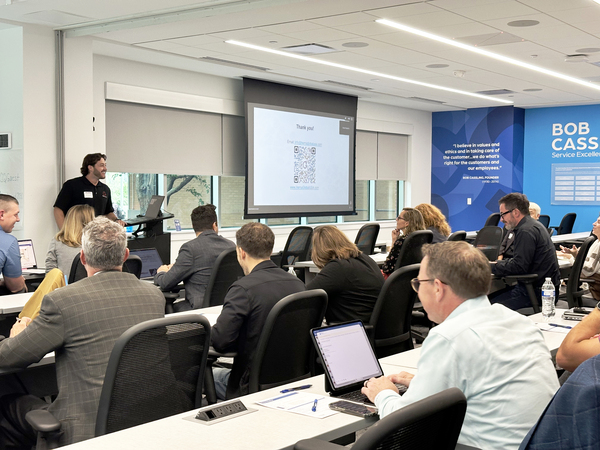
The resident mentor is one part of a broader approach to expert support. Milestones like the Midpoint Event and Final Pitch Expo give experienced leaders a chance to see founders in action. When there’s a real fit, those introductions can grow into founder-led advisory relationships that last well beyond the program.
Marcia Shade, RN, PhD, founder of VoiceIt and a member of the program’s first cohort, noticed the difference right away. “The advisor piece was missing from my last accelerator,” said Dr. Shade. “Everybody was so gracious and willing to share their knowledge.”
Lessons from the Resident Mentor, Dr. Linder
For its most recent cohort, Steel Works welcomed Dr. James Linder as resident mentor. Physician, health system CEO, founder and investor, he has sat on nearly every side of the table a healthcare founder will face.
At the University of Nebraska Medical Center, Dr. Linder served as a diagnostic pathologist, interim dean of the College of Medicine and leader of technology transfer at UNeMed. He was later interim president of the University of Nebraska system and, from 2018 to 2025, CEO of Nebraska Medicine. In business, he was Chief Medical Officer of Cytyc Corporation, co-founded Constitution Medical, which was acquired by Roche, and co-founded Tethon3D. He and his wife, Karen, have made 48 angel investments through Linseed Capital.
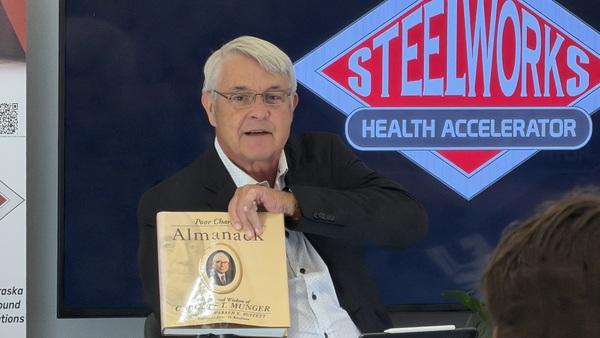
Rather than save his insights for one-on-one meetings, Steel Works built a fireside chat around him so the whole cohort could learn together, with alumni from the inaugural cohort joining too. Dr. Linder opened by saying he was “not Moses coming down from a mountain with knowledge engraved in stone,” just someone sharing what he has learned. He drew on stories from Cytyc's turnaround, a company sale that came before the team was ready, and decades of investing.
Dr. Linder closed with five takeaways for founders, which are helpful for anyone looking to build in healthcare:
1. Understand who you are.
“Who you are shapes your business,” Dr. Linder said. Your goals, the time you can give and the kind of company you build all flow from it. Because founders' identities and emotions get tied up in their companies, he recommended a stoic mindset: events are not inherently good or bad, and how you respond is what matters. His shorthand for character in business? “Hubris is toxic. Humility is powerful.”
2. Focus on the issues at hand, but keep a long-term view.
Founders have to solve today's problems without losing sight of where the company is headed. That long view also leaves room to change course. Dr. Linder noted that more than half of the companies in his investment portfolio have pivoted and are now doing something different than the founder first imagined.
3. Execute, because the competition is real.
A good idea is not enough on its own. Pointing to economist Joseph Schumpeter, Dr. Linder reminded founders that “there's always somebody out there that wants to eat your lunch.” Someone, somewhere, may be building a version of your idea right now. Execution is what sets you apart.
4. Have a customer.
“You don't have a business if you don't have customers,” he said. One of his own hard lessons was that “you should not be a technology searching for a problem.” In healthcare, customers also need a financial reason to say yes: “If people can't make more money using your test, they probably won't do your test.” At Cytyc, that meant a three-year effort to improve reimbursement before adoption took off. And when selling to a health system, his advice was clear: find a clinician inside who will advocate for you.
5. Give back.
Whatever success comes, Dr. Linder encouraged founders to mentor others who are starting out or, after a positive exit, to step into philanthropy. He practices what he preaches: about 70 students have gone through a summer research program he created at Iowa State. “Giving away money and making things happen that otherwise would not happen is a lot of fun,” said Dr. Linder.
The fireside chat was only the start. Each founder also schedules one-on-one time with Dr. Linder to dig into the questions specific to their company, carrying the conversation forward across the program. That kind of continuity of support is exactly what the resident mentor role was designed to provide.
How CQuence Supports Healthcare Founders
Steel Works is just one way CQuence partners with healthcare innovators. We work with founders and leaders across every stage of growth, helping them spot issues early and plan strategically. That support can begin with an idea that comes from a university lab and continue as a company scales.
It all connects to a bigger goal: a vision to improve healthcare access and outcomes, and impact one billion patient lives by 2030. Being a part of Steel Works helps us advance that mission and create exponential returns.
Ready to Build with the Right People Around You?
Whether you’re a founder with a healthcare idea ready to grow, or an experienced leader interested in giving back through mentorship, we’d love to connect.
Learn more about the Steel Works Health Accelerator here: https://www.cquencehealth.com/steel-works