 4 min read time
During an infectious disease outbreak, every second counts. But before frontline staff can even provide care to an exposed patient, they must first spend precious minutes layering on equipment like gloves, gowns, masks and shields to protect themselves from potential contagions.
It’s a necessary but time-consuming process, with a recent study finding that healthcare workers spend 1.3 hours donning and doffing in a single 12-hour shift. That hour is not only exhausting for staff, it also delays vital care and interventions, putting lives at risk.
This challenge is what led the team at Carecubes to ask a simple yet revolutionary question: why not wrap the protection around the patient instead of the provider?
A New Standard of Care
Carecubes’s solution is a new standard for infectious disease response: a deployable, scalable isolation technology that sets up in less than 20 minutes. By isolating the pathogen, healthcare staff can provide safer, more compassionate care while reducing the burden of personal protective equipment (PPE), a problem that took center stage during the COVID-19 pandemic as healthcare teams faced arduous PPE protocols overnight.
“We also witnessed the burdens they had on them beyond the actual care,” said Alex Laskey, CEO of Carecubes. “The burdens of wearing PPE and putting their own lives and health at risk as they treated patients.”
Aside from the physical and emotional strain on care providers, patients are also negatively impacted by the current procedural norms. When faced with a communicable disease, hospitals are often forced to isolate the patient in a solitary space with infrequent visits from doctors and nurses. This removes the patient from the support of loved ones, further depriving them of human connection.
“We believe that treating a patient under isolation doesn’t mean that the patient has to be isolated,” said Alex. “We get better care and we recover more quickly if we can have easy access to, not only our nurses and doctors, but our family members.”
Engineered for Safety and Efficiency
Carecubes’s innovative approach enables patients to interact with providers and family without sacrificing the compassionate care that improves patient outcomes. The FDA-cleared Carecube is a mobile isolation unit designed to be easily assembled within minutes, eliminating the need for costly brick-and-mortar construction.
“We provide a negative pressure enclosure that allows hospitals or other facilities to put the sickest patients into a negative pressure environment and allow basic care of the patient without wearing PPE,” said Alex. “This reduces the risk of infection…to the providers, but also reduces or eliminates the risk of transmission inside of hospitals.”
The ease and efficiency of the Carecube make it suitable for use in a variety of healthcare settings, from large health systems to long-term care facilities, preventing the spread of infectious diseases ranging from the measles to Ebola, COVID-19 and more.
Developed in the Heart of America for Global Impact
The Carecube was developed in collaboration with frontline staff and infectious disease experts at the University of Nebraska Medical Center (UNMC), a global leader in biocontainment, training and infectious disease response. UNMC is home to the Davis Global Center, an advanced simulation and training facility. The center has the nation’s only federally funded National Quarantine Unit, which provided the ideal setting for design and validation of the Carecube unit.
The unit’s design features intuitive elements, including lean-in glove walls, negative pressure exchanges, conduit panels for IV tubing and pass-through panels to allow healthcare staff to provide vital, uninterrupted care safely.
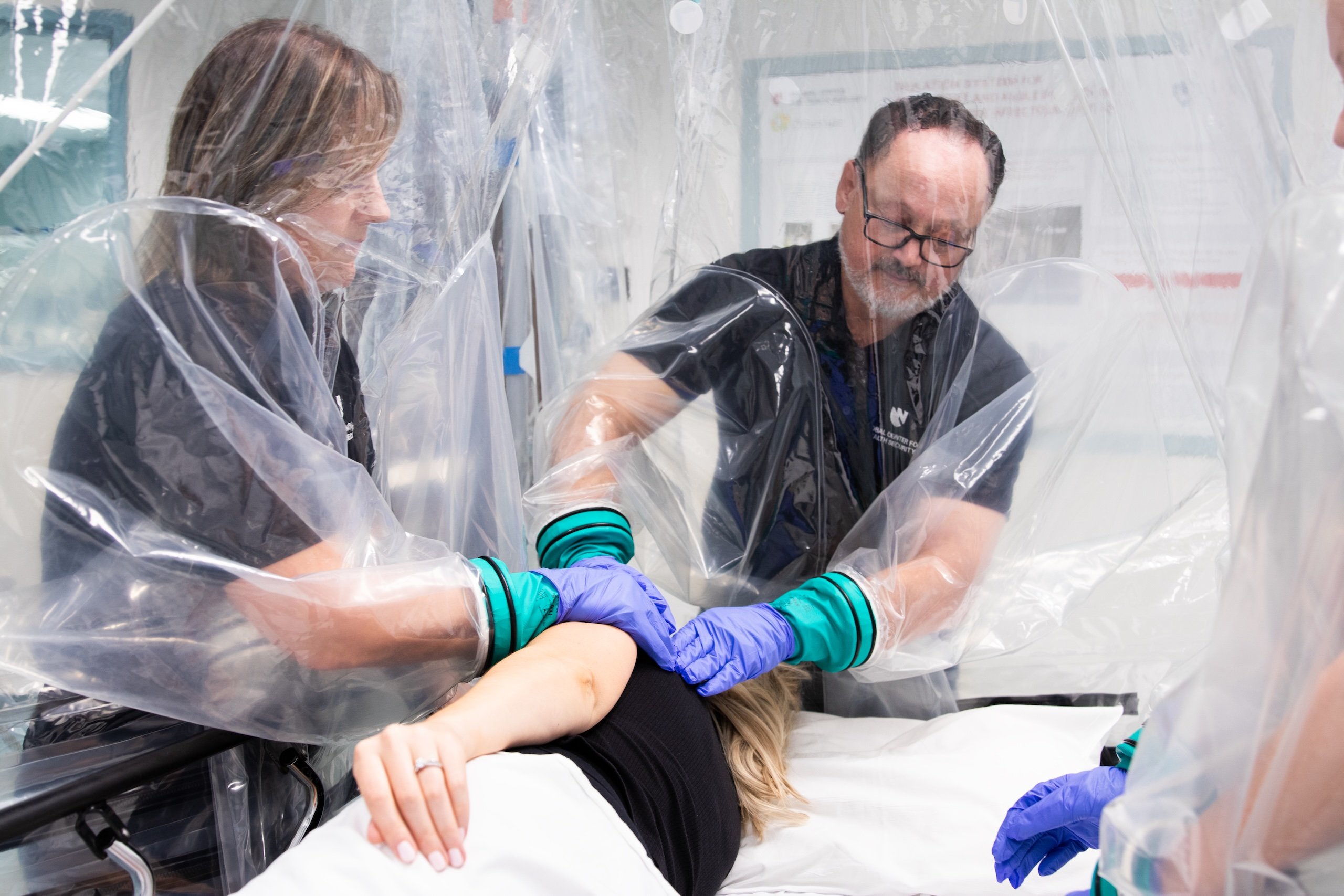
The partnership with UNMC’s experts ensured the Carecube was shaped by the lived experiences of the nurses, physicians and emergency responders who manage infectious patients. The result is a solution that balances clinical demands with practicality to enable safe care in the most complex scenarios.
The local connection was also the springboard for Carecubes’s partnership with Omaha-based CQuence Health. More than an investor, CQuence is partnering with Carecubes to provide strategic guidance, operational support and resources to help the company scale efficiently and sustainably.
“One of the things we find really exciting is the technology was developed locally. We like the idea that it is a hometown story,” said Kyle Salem, PhD, CEO of CQuence Health.
Prepared for the Unknowns of Tomorrow
It’s a hometown story that has the potential to transform care far beyond Nebraska. And it’s exactly why CQuence is empowering the team at Carecubes to bring its innovation to healthcare organizations around the world.
“Carecubes’s solution has the potential to change healthcare outcomes not just for hundreds of people, but for millions at a time,” said Kyle. “It deals with a global problem in a way that focuses on the triple aim in healthcare, which is improving the quality, lowering the cost, all while positively changing the impact on the people involved, particularly the patient.”
The global problem? High-consequence infectious diseases (HCIDs). Disease outbreaks like Ebola and Marburg have become recurrent threats across Africa. Even closer to home in the U.S., a rare and deadly case of Lassa Fever in Eastern Iowa recently kept bio-emergency response teams on their toes, highlighting the need for rapid, reliable isolation solutions in both developed and developing nations.
“We live in an increasingly connected world in which all kinds of diseases are emerging all over,” said Alex. “We want to be in a place where every hospital, no matter how well- or poorly-resourced, can have access to cutting-edge technology that allows nurses and doctors to provide exceptional care, and do it in a way that keeps people healthy.”
Improving and advancing emergency response is a necessary task for nations across the globe, and Carecubes exists to provide a rapid response solution that can keep populations safe from unknown threats whenever and wherever they emerge.
Protecting Against Everyday Risks
While emerging and rare pathogens demand urgent preparedness, many of the most persistent infection risks in healthcare settings come from routine viruses. Measles, bird flu and other highly transmissible infections continue to spread within hospitals and long-term care environments, where vulnerable populations and close-contact care create ideal conditions for spread.
“You’re going to the hospital to get healthy,” said Alex. “And all too often people come into hospitals, not just in this country, but all over the world, to get treated for one thing and they come out sick with something else.”
Because the Carecube is mobile and rapidly deployable, it can be used proactively in hospitals, long-term care facilities and post-acute care settings to safely manage infectious patients while preserving provider and family interactions. This approach helps healthcare organizations protect patients and staff while maintaining operational continuity and reducing the impact of viral outbreaks.
By addressing both everyday infection risks and HCIDs, Carecubes extends its impact beyond emergency response, supporting safer, more resilient care environments across the continuum of care.
Putting Patients and Providers First
Carecubes represents a new era of infectious disease preparedness, one where healthcare organizations are no longer forced to prioritize safety protocols at the expense of compassionate care.
By reimaging the problem of isolation, Carecubes is empowering providers and delivering human-centered care to patients when they need it most. The Carecube’s thoughtful design and global scalability are extending its impact far beyond individual facilities to improve healthcare outcomes for populations globally.
CQuence Health is proud to support Carecubes’s vision of safer, more compassionate care for both patients and providers. To learn more about Carecubes and their innovative solution, visit www.carecubes.com.